Novecento art movement
M: Son of the CenturyThe Novecento art movement brought a program of modern classicism into public view as part of the cultural order promoted under Benito Mussolini. Curated by Margherita Sarfatti, it sought to reconcile modern art with compositional discipline and a return to order. Its prominent 1924 exhibition appeared to confirm that ambition, yet the departures and disputes around it made the triumph less secure than its polished display suggested.
Identity and ambitions
The movement’s name, meaning twentieth century, presented it as an art for a new historical moment. In Milan, Mussolini inaugurated a Novecento exhibition at the Pesaro Gallery curated by Sarfatti. The episode placed the group within a broader public performance of the new regime: Sarfatti’s artistic project stood beside Mussolini’s other highly visible roles, while the exhibition gave cultural form to the claim that a new era was beginning.
The program was not simply a call for novelty. Sarfatti’s conception of a new artistic objectivity looked backward as well as forward, joining modernity to a renewed order of form. Geometric composition, cohesive design, and harmony of color were its stated foundations. Instead of treating the modern as a rejection of all inherited models, the project sought a disciplined modern classicism capable of making contemporary subjects appear composed and enduring.
A formal language of order
The exhibition’s examples made that ambition concrete. One especially telling image was Achilles Funi’s young worker portrayed as a Renaissance Madonna. The subject brought labor into the picture, while the Renaissance reference and the arrangement of the work connected contemporary life to an older visual language. The work therefore embodied the movement’s effort to make modern social reality legible through ordered, classical form.
This program also had a political resonance without being reducible to political decoration. Sarfatti’s conception treated artistic power as capable of standing on equal terms with political power and speaking a related language. In that alignment, the movement’s composure offered a cultural counterpart to the regime’s advertised order. Its aesthetic discipline could be presented not as withdrawal from public life but as a way of shaping the image of a new national present.
The Venice debut
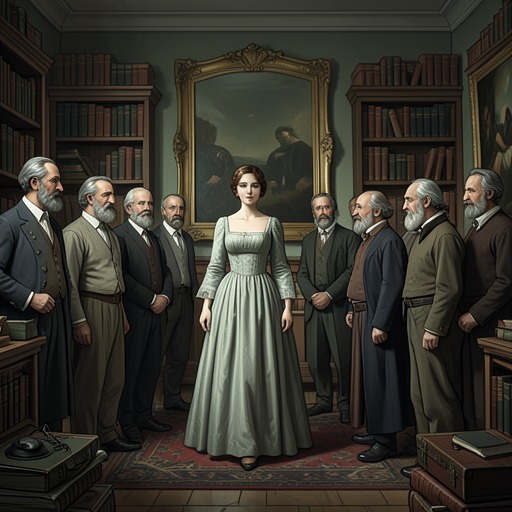
At the XIV International Art Exhibition of Venice, the fascist-era setting made the movement’s public appearance especially conspicuous. Black-shirted hierarchs received Vittorio Emanuele III in the exhibition garden, and Sarfatti presented the Novecento painters in a gallery reserved for them. She appeared among the artists and their carefully selected, thoughtfully arranged, spaced canvases: the only woman among six men in a cultural world dominated by men. The display was both an exhibition of paintings and a test of Sarfatti’s authority as a curator and advocate.
That test reached beyond the gallery. The works were shown to international delegations arriving from countries including Japan, Romania, the United States, Spain, France, Great Britain, Germany, and Russia. Sarfatti’s project was thus placed before an audience that exceeded Italy’s political and artistic circles. The ambition to make artistic authority count alongside political authority acquired a literal public stage: the movement’s formal language was presented internationally under the gaze of the monarchy and the fascist establishment.
The opening also exposed a contrast between the ordered presentation and the older avant-garde disorder it was meant to supersede. Filippo Tommaso Marinetti interrupted Giovanni Gentile during the ceremony with a protest against Venice’s supposed backwardness. The episode disrupted the proceedings, but the narrative treats Marinetti’s intervention as a comic remnant of Futurist chaos, not a serious challenge to the exhibition’s command. The king left early; the Novecento works, by contrast, were judged proficient, well selected, and well displayed. The new order appeared to prevail, though the victory already carried a note of defeat.
Defections and limits
The cracks had appeared before and after the opening. Shortly before the inauguration, Ubaldo Oppi, described as perhaps the group’s most representative painter, accepted Ugo Ojetti’s invitation to show his paintings in a separate room devoted to him. Giovanni Papini then attacked the group’s art as soft and swollen, and Anselmo Bucci, the youngest member, withdrew after the exhibition. These developments did not erase the quality of the display, but they showed that a coherent visual program did not guarantee a cohesive group.
Sarfatti’s position was similarly exposed to scrutiny. The account presents her both as the curator of the movement’s carefully ordered exhibition and as Benito Mussolini’s cultured lover, watched along with him by observers ready to judge them. In this setting, her cultural influence and her intimate connection to political authority could not be separated cleanly. The debut therefore tested more than a style: it tested whether Sarfatti could make artistic leadership appear autonomous and authoritative while operating within a cultural world structured by male power and political patronage.
Significance
The Novecento art movement’s significance lies in that tension between formal discipline and precarious authority. Its program supplied a clear visual proposition—modern subjects shaped by classical order—and the Venice exhibition gave that proposition international visibility. Yet Oppi’s separate showing, Bucci’s withdrawal, and Papini’s criticism revealed limits that the polished gallery could not conceal. Even Marinetti’s interruption served as a contrast: an older avant-garde gesture of disruption made the Novecento display look orderly, but also emphasized the movement’s dependence on a carefully staged account of cultural succession.
The exhibition could therefore be called a triumph in terms of selection, presentation, and public standing, but not an uncomplicated victory. The very occasion that elevated Sarfatti’s artistic program exposed its vulnerabilities: a group divided by individual decisions, a woman exercising authority in a male-dominated field, and an aesthetic project closely aligned with the regime’s claims to impose a new order. The movement’s public success and its internal disappointments arrived together.